


Zach Taylor
Aug 14, 2026
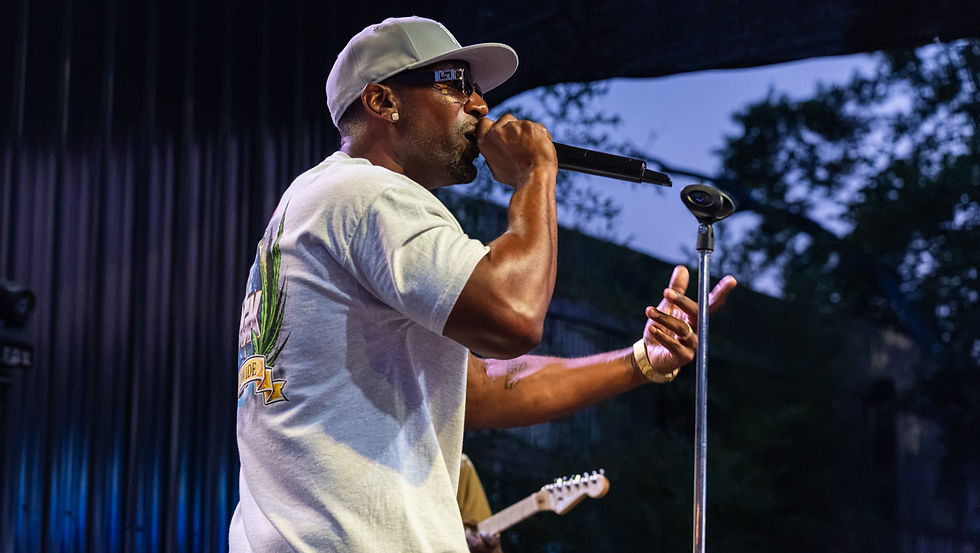
Dizzy D is shaping Huntsville's music scene one fan at a time.
Coming from a small rural school in North Alabama, my exposure to rap, R&B, and hip-hop was essentially zero, but by the time I graduated in 2001, rap, specifically Southern rap, had exploded and become part of my regular rotation of music. Big Tymers, Three 6 Mafia, Hot Boys, Master P and plenty more were in rotation just as much as, and sometimes more than, the grunge and classic rock I had grown up with. I had subwoofers in my trunk and was obsessed with getting every bit of sound out of them. As the years went on, though, that genre mostly fell by the wayside for me. I’ve still gone to see Lil Wayne and Snoop Dogg in concert, but I wasn’t actively keeping up with the scene.
Dizzy D is a rapper and producer from Huntsville, Alabama, and you can feel his roots in every track. His style? It’s got that unmistakable Southern hip-hop vibe, but he keeps it sharp with smart lyrics that really grab you. He started out in Huntsville’s underground rap scene, making a name for himself one show at a time. What really hits about his music is how much of his real life he puts into it—the tough times, the grit, and the moments that shaped him. So how did I come to learn about him?
One afternoon at The Camp in MidCity Huntsville, I thought I was going to see Juice, the local legendary funk and R&B cover band. Instead, plans had changed, and The Camp was hosting its Black Farmers Market weekend with live local talent. I ran into one of my former high-school teammates, who informed me that Derrick “Dizzy D” Pelt was performing. So, my wife and I stayed. At some point, I may have even ended up near the stage dancing. Poorly.
In 2023, at my wife’s 20th class reunion, I ran into Dizzy again. He had graduated with my wife. While I hadn’t known him particularly well in school, I had graduated with his brother, Shedrick Pelt, a renowned artist and activist. We talked about Shedrick. We talked about Dizzy’s career. And we both had a pretty good laugh at my story about The Camp.
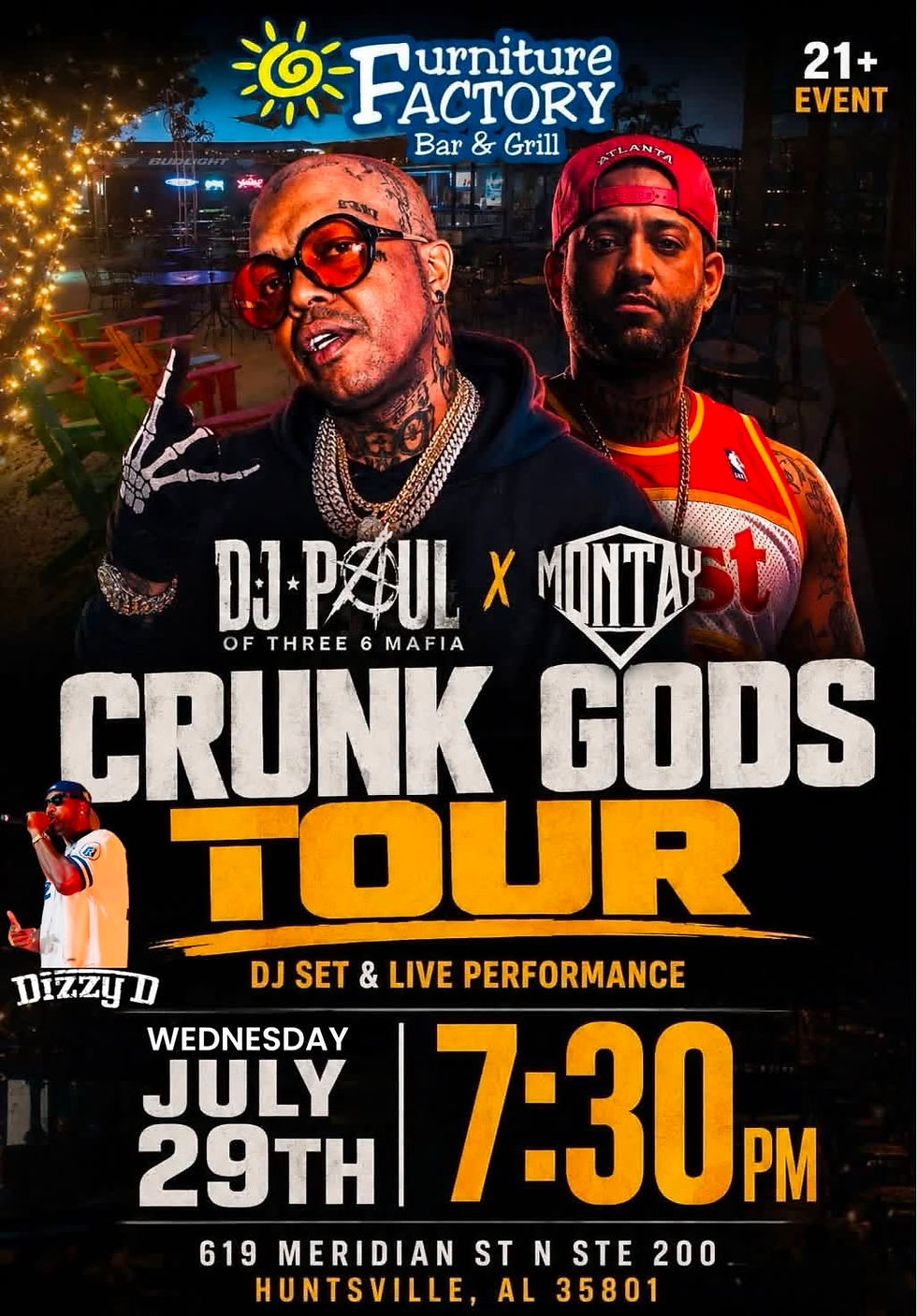
Now it’s 2026. Dizzy D has performed on major stages with artists including T.I. and P$C. We met at Huntsville’s Furniture Factory Bar & Grill before his show with the legendary DJ Paul of Three 6 Mafia, still my favorite rap group from that era. But before getting to DJ Paul, T.I. or the Orion Amphitheater, I wanted to start at the place where Dizzy D reentered my musical world: The Camp.
*this conversation has been edited lightly for clarity
MaM: That day at The Camp is really where this interview begins for me. What has The Camp meant to Huntsville hip-hop? Has it simply been another venue, or has it introduced the scene to audiences who might never intentionally attend a local rap show?
DIZZY D: Man, The Camp is super important. I was the first hip-hop act at The Camp. Before that, with hip-hop, it was more clubs and things like that. Then you had this open venue right there in MidCity, literally in the middle of the city. It could be free. Adults could go. Kids could go. It was just the place to be. I was there from the beginning of the first Camp, then the second Camp came along, and eventually I got involved with Hip Hop Live. I help curate Hip Hop Live at The Camp and book other hip-hop, rap, and other artists. It’s been successful.

MaM: And how important is that accidental discovery? If you’re playing a club and somebody bought a ticket specifically because they know you, that’s one thing. But somebody can walk into The Camp having no idea who is performing. That’s essentially what happened with me.
DIZZY D: That’s really important. A lot of times I’ll get offstage, and somebody will come up and say, “Hey, where can I find your music? You got music online?” You build all kinds of different fans that way. They might not have been focused on you at all. Playing at places like The Camp and Big Spring Park, and at events like that, puts you in front of a much broader audience. You get people who might have never heard of you otherwise.
MaM: Let’s talk about the records because you’ve got Elevation, The Huntsvillian, The Huntsvillian 2, Pine Grove and Rocket City. Those titles deliberately connect you and your music to a very specific place. Where do those names come from? And what were you claiming when you called yourself The Huntsvillian?
DIZZY D: Around the time of The Huntsvillian, blogs were really big. You had bloggers all over the place, California, Florida, everywhere. They would catch on to your music, post it, and then people would start following you through those blogs. I had a lot of fans outside of Huntsville from that. So, The Huntsvillian was really me saying, “I want you to know I’m from Huntsville.”

MaM: I came into the blogging era late myself with some bass-fishing stuff, right about the time everything was changing. Then blogging naturally moved into something else. You’ve survived all of those changes. How?
DIZZY D: I was talking to somebody about that the other day. I’ve been through so many different eras. When I first started rapping with Betta Half, we pressed our CDs up and sold them out of the trunk. You pulled up somewhere and sold your music. That was how you got it out. Then it became, “Okay, now you can put it on MySpace.” Then you had to figure out YouTube. Then all these other things came after YouTube. Now it’s TikTok and everything else. You just have to follow wherever the technology is going and stay on it. If this is where people are, and you want people to find your music, then you have to be there too.
MaM: Pine Grove is another one where that location seems very personal.
DIZZY D: Yeah. Pine Grove came from a point where I was still living out in Harvest, but life happened. I fell on hard times. I lost my house. I had to move back into my dad’s old house. That was the house where I lived while I was in middle and high school. I was around 28 years old, back in that house, around all those memories of growing up and all the shit I had gotten into on those streets. That became Pine Grove.
MaM: And that entire area is almost unrecognizable now. My first house was right there at Dexter Circle near Pine Grove, and when I drive through there today, I barely recognize it. That feeds directly into something I wanted to ask you. Huntsville has become a place that people outside this city suddenly have a lot of opinions about. What do people get right about Huntsville?
DIZZY D: They get right that Huntsville is very diverse. You all have different cultures and different undergrounds. You have rocket engineers, but you also have music artists and creatives. There are so many different things here. It’s a melting pot, especially for a city this size, especially in Alabama.

MaM: Let’s move into your music more because I’m listening to “She Don’t Understand,” and there’s a line that stopped me in my tracks: “I’m trying to be a father, not a strong Black man.” Where did that come from?
DIZZY D: That was actually Yung Tatt on the song. Yung Tatt was on the first version of that song. The song was basically about somebody not understanding all the hustling and grinding you’re doing. Why are you out at this time? Why do you have to go do this? It’s like, I’m still taking care of you. I’m still trying to provide for my family. That was basically what the song was about.
MaM: Does what you’re listening to at a particular moment affect what comes out when you sit down to create?
DIZZY D: Yeah. You still have remnants of those sounds in your head when you sit down to make something. I always listened to the people who had the cleverest bars, rhymes and schemes. People like Eminem, Canibus and Nas. I always liked that. I try to be clever with what I’m doing.
MaM: So, two brothers and two completely different artistic languages. Your brother, Shedrick, uses a camera as his canvas. You’re a rapper and performer. Two kids from Harvest, Alabama, who went in different directions creatively and both became artists in their own right. Are you two competitive with each other?
DIZZY D: That’s my brother, man. We’re two years apart, so we’ve always been super close. There’s never really been any competition. We always cheer each other on. I never really thought about it like that. We’ve always just done it. Around maybe the second Betta Half album, my brother said, “Hey, I’m getting into photography. Let me shoot some stuff for y’all.” So, he started working with us, doing photography, album covers, promotional graphics and stuff like that. Then he just kept building from there.

MaM: I’m fascinated by that because there was obviously something happening in that house. Two brothers, two years apart, both developing a creative eye but expressing it in completely different ways. All right, important journalism now. When you two played video games growing up, what did you play?
DIZZY D: Mortal Kombat.
MaM: Characters?
DIZZY D: Liu Kang. Sub-Zero. Scorpion.
MaM: I have an original Mortal Kombat 3 arcade cabinet in my garage that I got during COVID and fixed up. My kids play video games constantly, and I absolutely love kicking their asses up and down in those games. They basically quit playing against me. So, I appreciate this answer. Now, as I’ve gotten deeper into covering local music, one thing I’ve noticed in rock and country is how much artists support one another. People start side projects, guest on each other’s records, share bills, and collaborate. Is the Huntsville hip-hop scene like that too?
DIZZY D: Yeah. I love the Huntsville hip-hop community and what we’ve built here. Everybody sees each other at shows and events. It’s all love. We might be hanging out, and somebody says, “Hey, let’s get in the studio tomorrow.” I’m very collaborative. I’ve worked with so many artists around here. It’s about supporting each other. If I put somebody on a song, some of my fans hear them, and some of their fans hear me. There’s cross-networking there. And everybody knows how hard it is to do this.

MaM: We’re in the homestretch, and I’ve got a couple of good ones for you. We grew up during a fascinating time. In the late ’90s and early 2000s, rap was exploding. You had Master P. You had the Hot Boys. You had Three 6 Mafia. Hip-hop was everywhere. And everybody had a system in their car. Did you?
DIZZY D: Oh yeah. In high school I had three 12s.
MaM: You performed with DJ Paul. When the Smoke Clears is one of my favorite albums of all time. It came out my senior year, and I probably listened to that record as much as anything. What is it like sharing a stage here at Furniture Factory with somebody who has accomplished that much and whose music was part of your own life?
DIZZY D: Yeah, man. DJ Paul is a legend, man. Shout out, DJ Paul. I came up on his stuff and Three 6 Mafia. In high school, that’s what I was listening to. Three 6 all the time. The beats and everything they were doing. To come full circle and be doing a show with them? That’s nuts. At least for me personally.

MaM: And then you get another one of those moments. You perform at the Orion with T.I. The Orion is an award-winning venue in your hometown. You’re standing on that stage. Tell me what that felt like. And I want to add something to the question because I think this matters: you still had to wake up the next morning.
DIZZY D: What’s crazy is, when I got onstage, I just felt like I was performing. It’s so second nature to me to get up there and do my performance that I didn’t really take all of it in while it was happening. It probably hit me more the next day, when everybody started sending me videos and stuff. Then it was like, “Hey, I was on that stage.” That was a good feeling.

MaM: Everybody wants to be successful. But nobody can take an experience away from you. So, I’m going to end with this. After everything you’ve done, everything you’ve recorded and all these stages you’ve stood on, what do you want Huntsville to understand about Dizzy D that you still don’t think is fully recognized?
DIZZY D: I guess it goes back to my legacy. I just want people to go through my catalog and see everything that’s there. See the work. See the whole process.
MaM: You just said the word that is so important to me: legacy. But I think there’s something else somebody discovers when they go through that catalog. Growth. Everybody wants to come out of the gate with the hit. We want the first thing we make to be the best thing we’ve ever done and the best thing we ever will do. That isn’t life. So, when somebody goes back through your catalog, is seeing your growth just as important as hearing the music?
DIZZY D: Listen to my first album, Elevation. I was saying the most reckless shit. That was what I was doing at the time. I was partying all the time, chasing girls. I’ve always written my life into my music. So when you go back through it, you can gradually see that growth. You can hear something and know exactly where I was in my life at that time. It timestamps it.
Having something timestamped is different than nostalgia. While nostalgia looks backward, a timestamp simply marks where you were before life kept moving. Dizzy D has been at this for fifteen years, helping to grow a scene inside Huntsville just as the city experiences an artistic explosion. We Huntsvillians like to define the Rocket City as a cultural melting pot, and our music scene is no different.
For decades, Huntsville’s identity has been shaped by Redstone Arsenal, NASA, the FBI, and the U.S. Space & Rocket Center, but a city’s culture is also defined by the people creating within it. Artists like Dizzy D are helping the Rocket City live up to that reputation.
One fan at a time.
*All photos by Bud Gambrell Photography - the BEST in Huntsville!
For more information about Dizzy D:
Facebook:
Spotify:
Apple Music:
Bandcamp:
YouTube:
Where to find Zach Taylor:
Website:
https://sites.google.com/view/zach-taylor-author/home
TikTok:
zach taylor, author (@zachtaylorbooks) | TikTok
Facebook:
Where to find Bud:
Email:
the_budgambrell@mixedaltmag.com
Website:
https://bgambrellphotography.com
Amazon:
Facebook:
https://www.facebook.com/bud.gambrell
