


Bay Simpson Is Writing Muscle Shoals’ Next Chapter

Zach Taylor
Jul 6, 2026
The Muscle Shoals artist on songwriting, artistic identity, and why songs are everything.
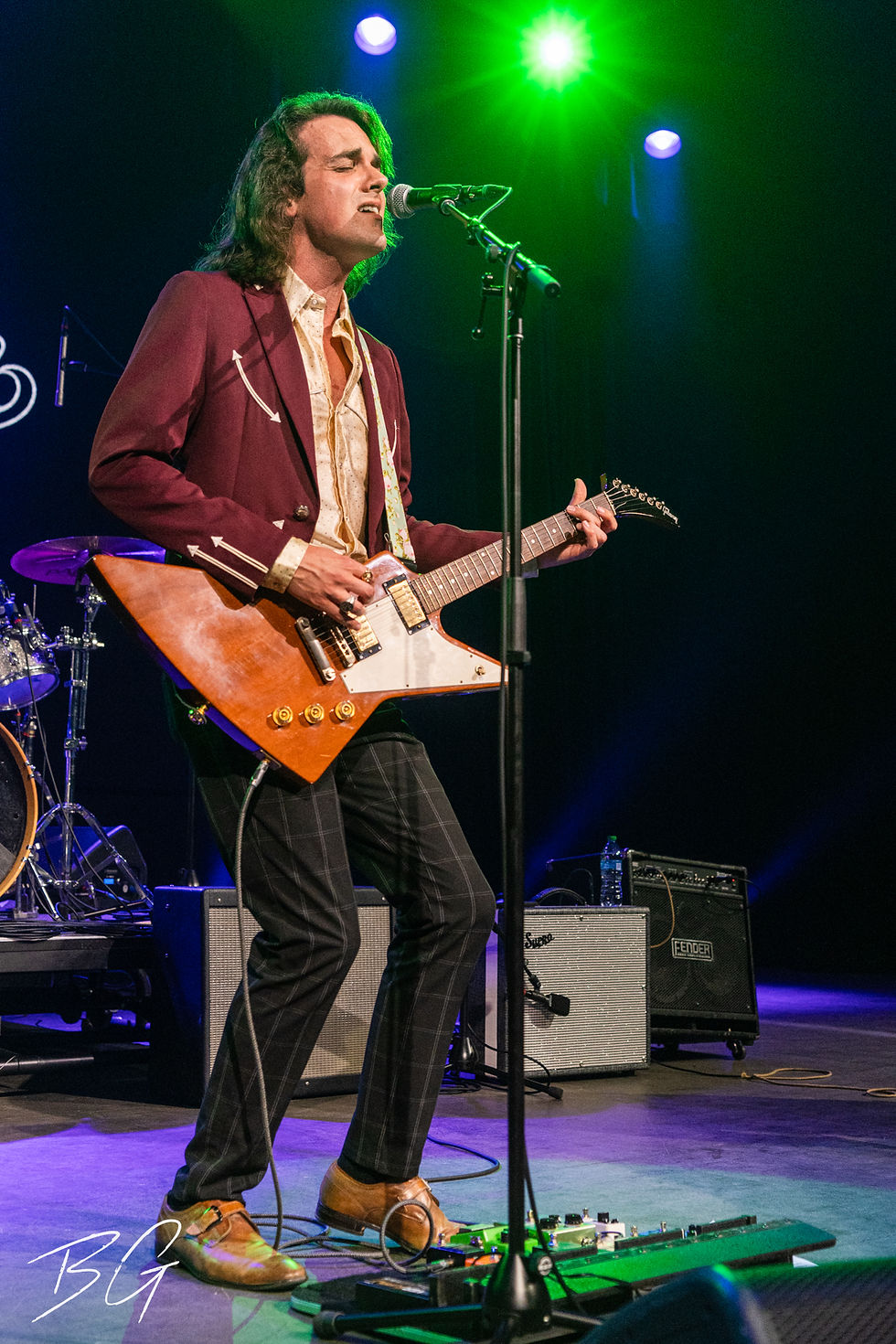
Bay Simpson speaks with the confidence of someone who knows his roots, even as he’s still discovering where he’s headed. And that’s important when your hometown is Muscle Shoals, Alabama.
For many, Muscle Shoals is almost mythical. Even if you’re not in the music industry, you probably know the legend. For me, it always felt like a landmark on the way to Pickwick Lake—a monument more than a living, breathing town. It’s a place frozen in black-and-white photos, old studio walls, and legendary names. But for Simpson, it’s more than legend—it’s home. For him, Muscle Shoals was fishing, the river, and growing up surrounded by music—long before he could grasp the size of its shadow. That’s what made talking with him so interesting.

Bay is anything but dismissive of the past. He lights up when talking about The Beatles, Tom Petty, The Who, The Everly Brothers, Zeppelin, the Stones—all the giants whose songs endure far beyond the moment they were made. But he’s also keenly aware of what it’s like to be a young artist today, where music has to compete with algorithms, shrinking attention spans, and the endless demand for content. Sometimes, it’s just content for content’s sake.
In other words, Bay Simpson isn’t trying to outrun Muscle Shoals’ history. He’s trying to keep it alive—without getting trapped by it.

I sat down with Bay backstage before his June 26, 2026 show at Huntsville’s Mars Music Hall. We talked about his name, Muscle Shoals, songwriting, time, regret, 'Fortunate Son,' artistic identity, and why, even with all the booking agents and PR, no one will ever care about an artist’s career as much as the artist themselves.
*The following conversation has been edited lightly for clarity.
MaM: Let’s start with your name. What is the origin of Bay?
Bay Simpson: There was an indie artist named Bay Chandler. My mom was about seven months pregnant with me, and I think she was going to name me Seth or something. Bay Chandler came and played at the little white amphitheater on campus, and my mom saw him play and loved the name. She said, “I’m going to name my kid Bay.”
MaM: Do you associate your name with anything? An image? A feeling?
Bay: Not really. I’ve always felt like my name made me unique because not many people have it. I like that aspect of it. When I think of a bay, I think of something closer to the ocean, for sure.

MaM: You come from the Muscle Shoals world. It is in your blood, and it has this almost mythological weight for people. Was it special to you growing up, or was it just home?
Bay: It was both. Growing up in it, being around FAME through my parents and stuff, you learn the history of it as you get older, and then it becomes cool. But to me, it was just a really cool place to grow up. I was on the river a lot. My dad was a big fisherman, so I was always familiar with the river and the lakes, whether it was Wilson, Pickwick, or Wheeler. I got to know the land pretty well, as well as the music scene. There’s definitely a mythical thing about it, sure.
MaM: Smallmouth, largemouth, or spots?
Bay: I’ve probably caught more largemouth than anything else, but there’s nothing like catching smallmouth.
MaM: What do people get wrong about Muscle Shoals?
Bay: In the music world, people see Muscle Shoals and associate it with the 1950s or 1960s. But there are still many mainstream ties in the modern day. Jason Isbell is from the Shoals. He grew up writing at FAME. That was his first deal. Chris Tompkins is from the Shoals, and he’s one of the most decorated songwriters in modern Nashville country. John Paul White is another current Shoals guy who had a ton of success, won a Grammy, and played on the Grammys. The misconception is that Muscle Shoals is a thing of the past. It’s still a thing. For me, I just want to carry it on. I want to keep it current and add to the legacy.

MaM: That brings up something I think gets overlooked. People think about the product, but you’re talking about songwriting. Do you think songwriting is an underrated part of the music industry?
Bay: Oh yeah. I think it is what makes the icons who they are. Nobody would see Tom Petty or Paul McCartney as these Mount Rushmore figures if they didn’t have songs people will sing forever. The Beatles were sixty years ago, and people still know so many choruses of so many songs.
As an artist, yeah, you can have a hit. You can have a moment of success. A lot of people do. But some of them are more memorable than others, and to me, that goes back to the songs. Ultimately, we’re in the songs business. Songs are everything.
That idea—that songs are what survive—became the thread running through the rest of our conversation. I found myself thinking about the music I grew up loving, especially the influence of the Seattle scene. Some songs live on, even when the artists who wrote or performed them are gone. The music endures.
Bay Simpson may come from Muscle Shoals, but he’s not interested in treating that legacy like a museum piece. He’s focused on what lasts, what fades away, and what it means to make guitar-driven music in a world that often feels more interested in content than in actual songs.
From there, our conversation turned to influence, time, attention spans, regret, and the sound he’s still chasing.

MaM: Listening to your music, I picked up on some Beatles influence. Was that a major influence for you?
Bay: I have a lot of Beatles influence. I have a lot of Tom Petty. I have a lot of ’90s influence, too, and much of that came from The Beatles.
I’ve studied so many bands. Most of the iconic rock bands of the time. I was a Zeppelin fan and a Stones fan primarily, and then it wasn’t until later, probably five or six years ago, when I first got into my twenties, that I really started to appreciate and understand The Beatles.

MaM: One thing I noticed in your writing is how often the idea of time shows up. “Time Waster.” “A Thousand Years From Now.” “Too Old for This.” “21st Century.” You’re still in your twenties, but time seems to weigh heavily on your mind. Why do you think that is?
Bay: I think a lot of it comes from the stuff I’ve always been drawn to. It is typically the stuff of the past. Those are my biggest influences.
Being in this modern era of music is tough, man, because it's less about the music and more about who can make the best social media content. To me, that is unfortunate. There are still people whose music rings true, and that is the reason people like them. BlackBerry Smoke is an example. But I am constantly thinking, “What would it have been like fifty years ago? What will it be like fifty years from now?” We are already in a place where attention spans are so short. I’m only in my twenties, and I’m sitting here thinking, “If people’s attention spans are only about ten seconds now, what are they going to be when I’m seventy?” I stay in that headspace. Plus, I’m a nerd. I’m a Star Wars nerd. I like old alien movies. Space, time, and all that stuff are cool to me.
MaM: There is angst and regret in some of your songs, especially the breakup songs. But then you also cover “Fortunate Son,” which is interesting because that song carries a lot of generational anger. Do you feel any dissatisfaction with the world you inherited, or am I reading too much into that?
Bay: I would not say that exactly. I am a big believer that everything is relative. There is nothing new under the sun. History repeats itself. My reason for covering a song like that is, first, because I love it. That is some of the coolest music ever. And second, my granddad was a Vietnam veteran, and he has told me stories about flying into battle listening to that song, which is crazy to me because it is literally like a scene from Forrest Gump. I do have moments where I think, “Man, I wish I had existed in a time when music seemed to be the thing.” But then I also have moments when I think maybe it has always been a bit of a gimmick.
MaM: So maybe it is less about dissatisfaction and more about bringing back a sound or a feeling that you think still has a place?
Bay: That is more so the deal. An artist's career is so challenging. I love it, don’t get me wrong. I would not do anything else. But I would not be doing it if I did not feel I had a space to carve out for myself. If I did not feel like I had something to say or that I could fill a space that needed to be filled, I do not think I would be doing it. And I do feel that way about what I do and who I am as an artist.
MaM: In ten years, what does Bay Simpson sound like? What sound are you chasing?
Bay: I feel like the sound I am chasing is already there in a lot of respects. I feel like the way I sing is already pretty unique, and I know who I am as a songwriter and as a player.
For me, the focus has been on how to get to the next level. That comes with putting in the time, putting in the hours, and figuring out how to really connect with fans. A lot of luck plays into music and who blows up and who does not. But the ones who stay in it and keep working are the ones who get those breaks. So, I am just going to keep writing, keep doing what I love, and keep writing what I want to say and what I want to hear until something really breaks through and goes to the next level.

This is where the conversation struck me personally.
Bay Simpson transitioned from an artist with songs I could relate to into an artist and a person I could relate to. Bass fishing and Star Wars helped, sure. Those things made him human. Familiar. But what connected with me most was the struggle. The grind. The strange, frustrating reality of trying to make something meaningful in a world that often rewards visibility before substance.
As a debut independent author, I have experienced firsthand many of the struggles Bay referred to: shrinking attention spans, constant content creation, the pressure to promote yourself, and the waiting. Always the waiting. Waiting for the right person to notice. Waiting for the work to break through. Waiting for talent, timing, effort, and luck to finally land in the same room.
There are plenty of sayings on motivational posters about how the only things you can control are yourself and your work ethic. There is truth in that. But it is naive to believe dedication, work ethic, and even raw talent automatically translate to success. It takes more than that. And Bay knows it.

MaM: As you’ve grown and become more established, is there anything you used to have to do yourself that you can now hand off to somebody else?
Bay: That is a big misconception in the business. Even the people who are successful still have to keep their hands in everything. I have a booking agency, but you still have to hound it to get gigs. That is just how it is. I have PR. I have people like that, and they are great, and they do a great job. But as an artist, especially now, there is no shortage of artists out there trying to get everybody’s attention. You have to be the one who drives the ship. There are certain things I have handed over, but I still keep my hands in everything I do. Nobody cares about my career as much as I do, and that will never change, no matter how big it gets.

MaM: You have a rider. What do you put on your rider? Is there anything funny on there, and what does it say about you?
Bay: My rider does not have anything crazy on it, and that probably says a lot about me. I am just pretty professional. I just kind of roll in. I am not one of those high-maintenance people. I just want some Coke and some water. Throw us some pizza or put some chips out. Something like that.
MaM: You put a lot of emphasis on songwriting, both your own and other people’s. If one artist could cover one of your songs, who would it be and why?
Bay: I would probably bring somebody back from the dead and say Prince. Somebody like Prince is just the coolest. Very artistic. I think he could do a cool version of “A Thousand Years from Now.”
MaM: Tell me about the origin of "Where Do I Go From Her." When I saw the title before hearing the song, I wondered if you had written down “Where do I go from here?” after a heartbreak and then scratched off a letter.
Bay: It was just one of those clever things that falls out. It does not come from trying. Somebody probably said, “Where do I go from here?” and I thought it would be interesting if you changed it. It is a breakup song. Sometimes, if I have a title I know is really good, then it becomes about coming up with the coolest possible melody.
I took that into a co-write and ended up with that jangly chord progression. I am a big fan of The Who, so I like acoustic-guitar rock and the way you can use acoustic guitar rhythmically, kind of like Pete Townshend did or like The Everly Brothers. That was one where I wanted to write a song with a driving acoustic track. I had that rocking chord progression, and it just kind of fell out. There is not much science behind it. You just do it until the heavens, or whatever you want to call it, open up.
And there it goes.
Bay Simpson may be chasing something old, but he does not sound stuck in the past. He sounds like an artist trying to figure out how to make songs matter now. In a world built on clips, scrolls, and seconds, that might be the most Muscle Shoals thing about him. Go check out his music today on your favorite streaming platform. It's incredible.

Where to find Zach Taylor:
Website:
https://sites.google.com/view/zach-taylor-author/home
TikTok:
zach taylor, author (@zachtaylorbooks) | TikTok
Facebook:
Where to find Bay Simpson:
Website:
TikTok:
baysimpsonmusic (@baysimpsonmusic) | TikTok
Instagram:
Bay Simpson (@baysimpsonmusic) • Instagram photos and videos
Facebook:
Spotify:
Apple Music:
Where to find Bud:
Email:
the_budgambrell@mixedaltmag.com
Website:
https://bgambrellphotography.com
Amazon:
Facebook:
https://www.facebook.com/bud.gambrell
